AI Music Copyright: Who Owns AI-Generated Songs? (2026)
AI music copyright explained: can AI-generated songs be copyrighted, what changes if you wrote the lyrics, how to register them, and whether you can sell them.
AI music raises two different questions that are easy to mix up: whether anyone owns a copyright in the song, and whether you are allowed to use it. This guide explains both for the United States, with links to the primary sources.
This is general information, not legal advice. For a specific release or contract, talk to a qualified lawyer.
AI music copyright: the short answer
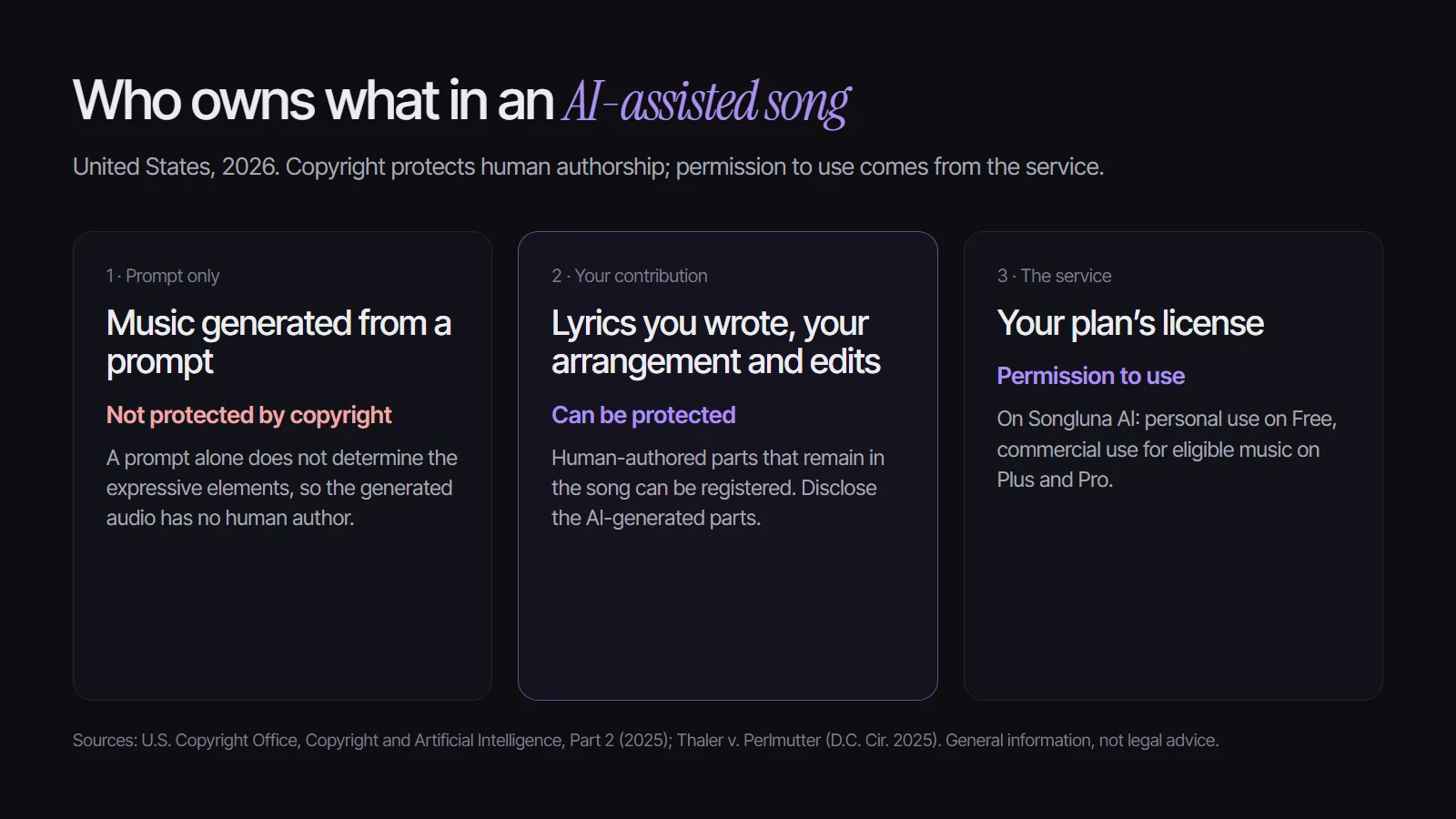
- Music generated entirely by AI from a prompt is not protected by U.S. copyright.
- The parts a person creates, such as lyrics you wrote or your own arrangement and edits, can be protected.
- Copyright and permission to use are separate: the service you use grants you rights to use its output through its terms and your plan.
- When you register a song that contains AI material, you disclose the AI part and claim only the human part.
Can AI music be copyrighted?
Not on its own. In January 2025 the U.S. Copyright Office concluded that AI output is protected only where a human author determined sufficient expressive elements. Writing a prompt, however detailed, is not enough, because the model decides how the music is expressed (Copyright and Artificial Intelligence, Part 2).
The courts agree. In Thaler v. Perlmutter the D.C. Circuit held that a machine cannot be the author of a copyrighted work (opinion, March 2025), and the Supreme Court declined to review that decision on March 2, 2026 (docket 25-449).
What if you wrote the lyrics?
Then the lyrics are yours. The Copyright Office's report explains that human-authored material that remains perceptible in an AI output, such as your lyrics, can be protected, even when the music around it was generated. The same goes for your creative selection, arrangement and modification of AI output.
That makes writing your own lyrics the simplest way to add protectable human authorship to an AI song. Tools such as Lyrics to Song keep your words intact while generating the music.
How to register a song that contains AI material
The Copyright Office's registration guidance asks applicants to disclose AI-generated material in a work and to describe the human author's contribution, so that the claim covers only what a person created (registration guidance, March 2023). In practice that means:
- Claim the parts you created, such as the lyrics or your arrangement.
- Disclose that the music, or the parts of it you did not create, were generated with AI.
- Keep your drafts, lyric files and edit history as evidence of your contribution.
Copyright is not the same as permission to use
Even if nobody owns a copyright in a generated track, you still need the right to use it. That comes from the terms of the service that generated it. On Songluna AI, paid plans include commercial-use rights for eligible generated music and the Free plan is for personal use; Commercial Use explains what each plan allows.
Because purely AI-generated audio may not be protected, someone else could reuse an unmodified track without infringing a copyright. Adding your own lyrics, arrangement or performance makes your release stronger and easier to defend.
Can AI music infringe someone else's copyright?
It can, mainly through what you put in. Uploading a song you do not own, pasting someone else's lyrics, or prompting for an imitation of a specific artist can lead to a result that copies protected material. Use your own words and audio, describe a sound rather than naming an artist, and listen for close similarities before you release.
How AI models may be trained on copyrighted music is a separate, ongoing policy and legal debate; the Copyright Office addressed it in Part 3 of its AI report, released in pre-publication form in May 2025 (Copyright and Artificial Intelligence).
AI music on YouTube and streaming services
Platforms add their own rules on top of copyright law. YouTube requires creators to disclose realistic AI-generated content, including AI music that is the main focus of a video. Streaming distributors and stores publish their own AI policies; read them before you upload, and keep your plan and generation records in case a claim needs to be resolved.
A checklist before you publish
- Use lyrics, audio and references you created or have permission to use.
- Generate on a plan that includes commercial use if the release earns money.
- Add your own lyrics, arrangement or edits where you can.
- Keep records: prompts, lyric drafts, the plan you used and the export date.
- Follow the platform's AI disclosure rules.
- If you register, disclose the AI-generated parts and claim only your contribution.
Frequently asked questions
Is AI music copyrighted?
Not when it is generated entirely by AI. U.S. copyright protects only the parts a human author determined, such as lyrics you wrote or your own arrangement and edits.
Can you copyright an AI song if you wrote the lyrics?
Yes, the lyrics you wrote can be protected. When registering, disclose that the music was AI-generated and claim the lyrics and any other parts you created.
Is AI music copyright free?
Purely AI-generated audio may not be protected by copyright, but that does not make every AI song free to use: the generating service's terms decide what you may do with it, and human-written parts such as lyrics can still be protected.
Can I sell AI-generated music?
Yes, if the service that generated it allows commercial use. Selling commercial AI music needs a license from that service, not a copyright registration; on Songluna AI, paid plans include commercial-use rights for eligible music and the Free plan is for personal use. Your copyright covers only the parts you wrote, so others may be able to reuse an untouched track. See Commercial Use.
Can I use AI music on YouTube?
Yes, if your plan allows it. YouTube asks you to disclose realistic AI-generated content, including AI music that is the main focus of a video. On Songluna AI, paid plans include commercial-use rights for eligible music.
Who owns AI-generated music?
In the U.S., nobody holds copyright in purely AI-generated material. You can own the parts you wrote, arranged or performed yourself, and the terms of the service you used decide what you may do with the output.
Who owns songs made with Songluna AI?
Songluna AI's terms and your plan decide how you may use the music: personal use on Free and commercial use for eligible music on paid plans. Copyright in the song depends on your human contribution, as explained above.