Vocal Range Test
A free vocal range finder: sing your lowest and highest notes to see your range, its span and your closest voice type, from bass to soprano. Your voice never leaves your browser.
- Start the test and warm up with a few easy notes.
- Slide down to your lowest comfortable note and hold it for a second.
- Slide up to your highest comfortable note and hold it. Do not strain or shout.
- If a note was missed, set it with the menus below.
Free, no sign-in. Your voice is analyzed in your browser and never recorded or uploaded.
Your vocal range appears here
- Lowest
- —
- Highest
- —
- Span
- —
- Closest voice type
- —
Typical choral ranges; individual voices vary.
How to test your vocal range
- 1
Warm up and start the test
Hum or sing a few easy notes first, then select Start the test and allow microphone access. This vocal test takes about a minute.
- 2
Sing your lowest and highest notes
Slide down to your lowest comfortable note and hold it for a second, then slide up to the highest note you can sing without straining. A note counts once you hold it steadily; quick slides and breaths are ignored.
- 3
Read your range and voice type
The result shows your lowest and highest notes, the span in octaves and semitones, and the voice type whose typical range yours covers best. If a note was missed, set it with the menus.
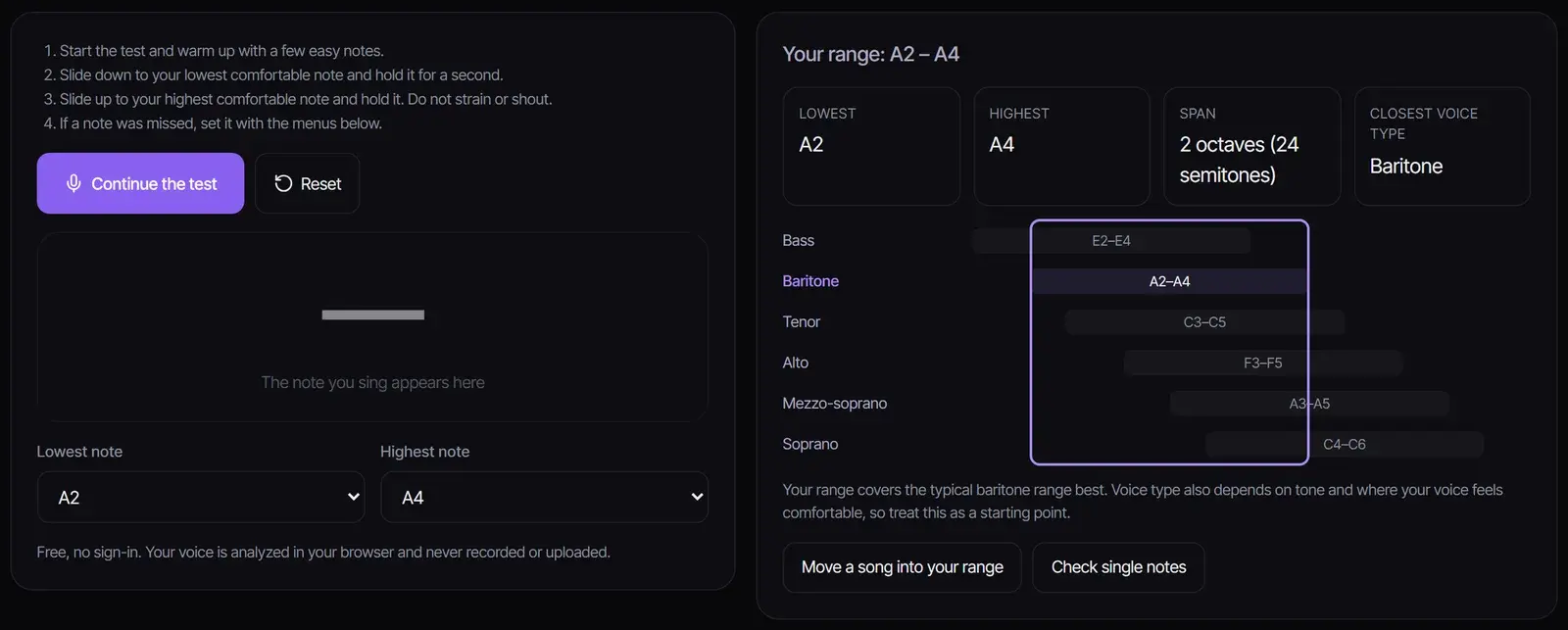
Voice types and their typical ranges
| Voice type | Typical range | Where it sits |
|---|---|---|
| Bass | E2–E4 | Lowest standard male voice |
| Baritone | A2–A4 | Between bass and tenor |
| Tenor | C3–C5 | Highest standard male voice |
| Alto | F3–F5 | Lowest standard female voice |
| Mezzo-soprano | A3–A5 | Between alto and soprano |
| Soprano | C4–C6 | Highest standard female voice |
Notes use scientific pitch notation: C4 is middle C, and the number goes up by one at each C. A4, the A above middle C, is 440 Hz.
Use it as a vocal range calculator
No microphone, or you already know your notes? Choose your lowest and highest notes in the menus and the tool works out the span and the closest voice type, just as it does after a sung test.
How to get an accurate result
- Warm up first. Cold voices lose a few notes at both ends.
- Sing at a comfortable volume in a quiet room, close to the microphone.
- Hold each end for about a second. The test only counts a note you hold steadily.
- Count only notes you can sing with control. Shouted or strained notes are not part of your usable range.
- Decide about falsetto. Light upper notes (falsetto or head voice) extend the range; test with and without them to see both.
Range is not the whole voice type
Voice type also depends on tone color, on where your voice feels most comfortable (the tessitura) and on where it changes register. Two singers with the same range can be different types, so treat the closest voice type as a starting point; a voice teacher can confirm it.
Sing songs in your range
If a song sits too high or too low, move it into your range with the Pitch Changer: each semitone up or down moves every note by the same amount. To check single notes while you practice, use the Pitch Detector. To hear a new song sung in a voice like yours, try the AI Singing Voice Generator.
Frequently asked questions
What is my vocal range?
Your vocal range is the span from the lowest to the highest note you can sing with control. Sing both into the test above to find yours; many untrained voices span about one and a half to two octaves.
Is this a voice type test?
Partly. It suggests the voice type whose typical range matches yours best. Tone color and where your voice is comfortable matter too, so use the result as a starting point.
What is a good vocal range?
There is no single good range. Many pop melodies stay within about an octave and a half, so a range of around two octaves covers most of them; training can extend it over time.
Can my vocal range change?
Yes. Warm-ups, practice and healthy technique can extend it over time, while a cold, fatigue or age can narrow it.
Is my voice recorded or uploaded?
No. During the voice test the microphone is analyzed in your browser; nothing is recorded, stored or sent anywhere.
Is this vocal range test online free?
Yes. It is free with no sign-in, and it works on recent versions of Chrome, Edge, Firefox and Safari.
Updated October 30, 2026 · Written and reviewed by the Songluna AI team
Hear a song in a voice like yours
New accounts get 8 free credits for AI singing voices and the AI song maker. No credit card required.