Pitch Detector
A free pitch finder and note finder: sing or play into your microphone to see the note, octave, frequency and tuning in real time, or upload a recording. Nothing is uploaded.
Free, no sign-in. Audio is analyzed in your browser and never uploaded. One note at a time works best.
How to find the pitch of a note
- 1
Start the microphone or upload audio
Select Start microphone and allow access, or upload a recording (MP3, WAV, M4A, FLAC or OGG up to 25 MB). No microphone? Try the sample melody to see how it works.
- 2
Sing, hum or play one note
Hold a single note close to the microphone in a quiet room. The detector reads about 20 times a second; a voice or one instrument works best, while chords and full mixes are harder to read.
- 3
Read the note, frequency and tuning
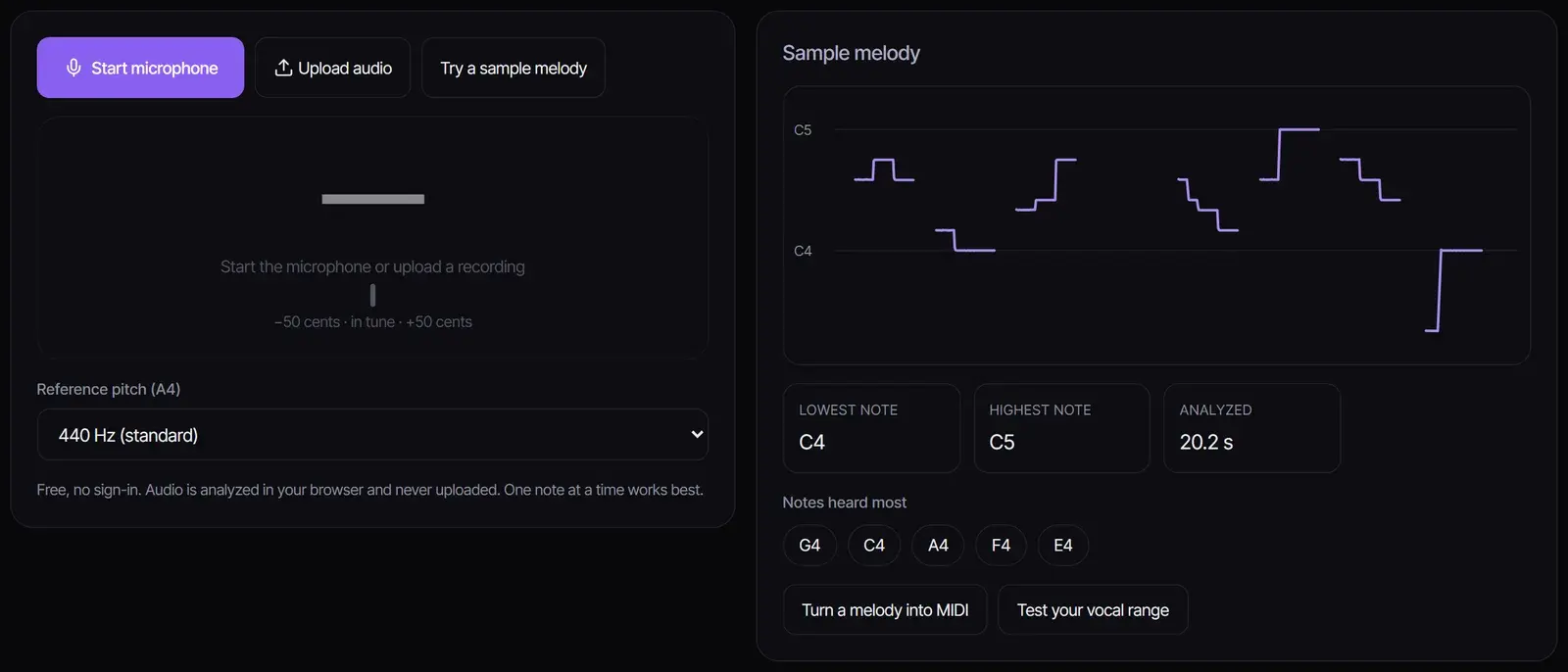
The large letter is the note and the small number its octave; middle C is C4. Below it you see the frequency in hertz and how many cents you are above or below the note. For a recording, the graph shows the pitch over time with the lowest, highest and most common notes.
How to read the pitch detector
- Note and octave. Notes use scientific pitch notation: A4 is the A above middle C (C4), and the number goes up by one at each C.
- Frequency. The pitch in hertz (Hz). A4 is 440 Hz in standard tuning, and every octave doubles the frequency.
- Cents. A cent is one hundredth of a semitone. The needle shows how far you are from the nearest note, from −50 (flat) to +50 (sharp); within 5 cents counts as in tune.
- Graph. The line shows your pitch over the last 10 seconds, or over the whole recording, against a grid with one line per C.
Note frequencies
| Note | Frequency | Note | Frequency |
|---|---|---|---|
| C2 | 65.41 Hz | C4 (middle C) | 261.63 Hz |
| E2 | 82.41 Hz | E4 | 329.63 Hz |
| A2 | 110.00 Hz | A4 | 440.00 Hz |
| C3 | 130.81 Hz | C5 | 523.25 Hz |
| E3 | 164.81 Hz | A5 | 880.00 Hz |
| A3 | 220.00 Hz | C6 | 1,046.50 Hz |
Use it as a voice pitch analyzer
Hold a note and watch the needle to see whether you are singing flat or sharp, then adjust until it settles in the middle. The detector covers roughly 60 Hz to 1,400 Hz, from below a bass singer’s low E to above a soprano’s high C. To find the lowest and highest notes you can sing, use the Vocal Range Test.
Tune instruments and find notes
It also works as a pitch identifier for single notes on guitar, bass, violin, piano, ukulele or a whistle. Chords and full mixes contain several pitches at once and are harder to read. To find the key of a whole song, use the Key & BPM Finder; to turn a melody into editable notes, use MP3 to MIDI.
440 Hz, 432 Hz or 442 Hz?
Standard tuning sets A4 to 440 Hz. Some musicians prefer 432 Hz, and some orchestras tune slightly higher, often to 442 Hz. Choose the reference that matches how your instrument is tuned; the note names and cents follow it.
Frequently asked questions
How do I find the pitch of a note?
Start the microphone and sing, hum or play the note. The detector shows the note name, octave and frequency right away; hold the note steadily for the most stable reading.
What do cents mean on a pitch detector?
A cent is one hundredth of a semitone. A reading of −20 cents means you are slightly flat; within 5 cents of zero is in tune for most listeners.
Can it detect my singing voice?
Yes. It reads voices from roughly 60 Hz to 1,400 Hz, which covers bass to soprano. For your full range, use the Vocal Range Test.
Can it find all the notes in a song?
It reads one note at a time. Upload a recording of a single voice or instrument for the clearest result; for the notes of a whole melody as a file you can edit, use MP3 to MIDI.
Why does the reading jump an octave sometimes?
Breathy notes, strong overtones or a noisy room can briefly confuse any pitch detector. Sing a little closer to the microphone and hold the note steadily; brief jumps settle on their own.
Is this pitch detector online free?
Yes. It is free with no sign-in, and the audio is analyzed in your browser: nothing is recorded or uploaded.
Sources
- A fundamental frequency estimator for speech and music (YIN)The Journal of the Acoustical Society of America, 2002
Updated October 30, 2026 · Written and reviewed by the Songluna AI team
Turn your melody into a song
New accounts get 8 free credits for the AI song maker. No credit card required.