
Suno Prompts: Style Formula, Metatags and 12 Examples (2026)
Suno prompts that work: the style formula, what goes in Style, Lyrics and Exclude, metatags for song structure, and copy-ready examples for 12 genres.
The best Suno prompts are short, specific and in the right field, and that holds for Suno AI prompts in Songluna AI and on suno.com alike. Most "bad" results come from vague style words, lyrics without section tags, or instructions typed into the wrong box. This Suno prompt guide covers the formula that works, where each part goes, and examples you can copy.
Want the prompt built for you? The free Suno Prompt Generator assembles style tags and a lyrics template from a few clicks.
Suno prompts: the short version
- Lead with the genre and sub-genre.
- Add the mood, two to four key instruments, the vocal type and a BPM number.
- Finish with a production word, such as "warm analog" or "polished studio mix".
- Put your words, with a tag like [Verse] or [Chorus] before each section, in Lyrics.
- List anything you do not want in Exclude Styles.
- Generate two or three times before changing the prompt.
Where each part of a prompt goes
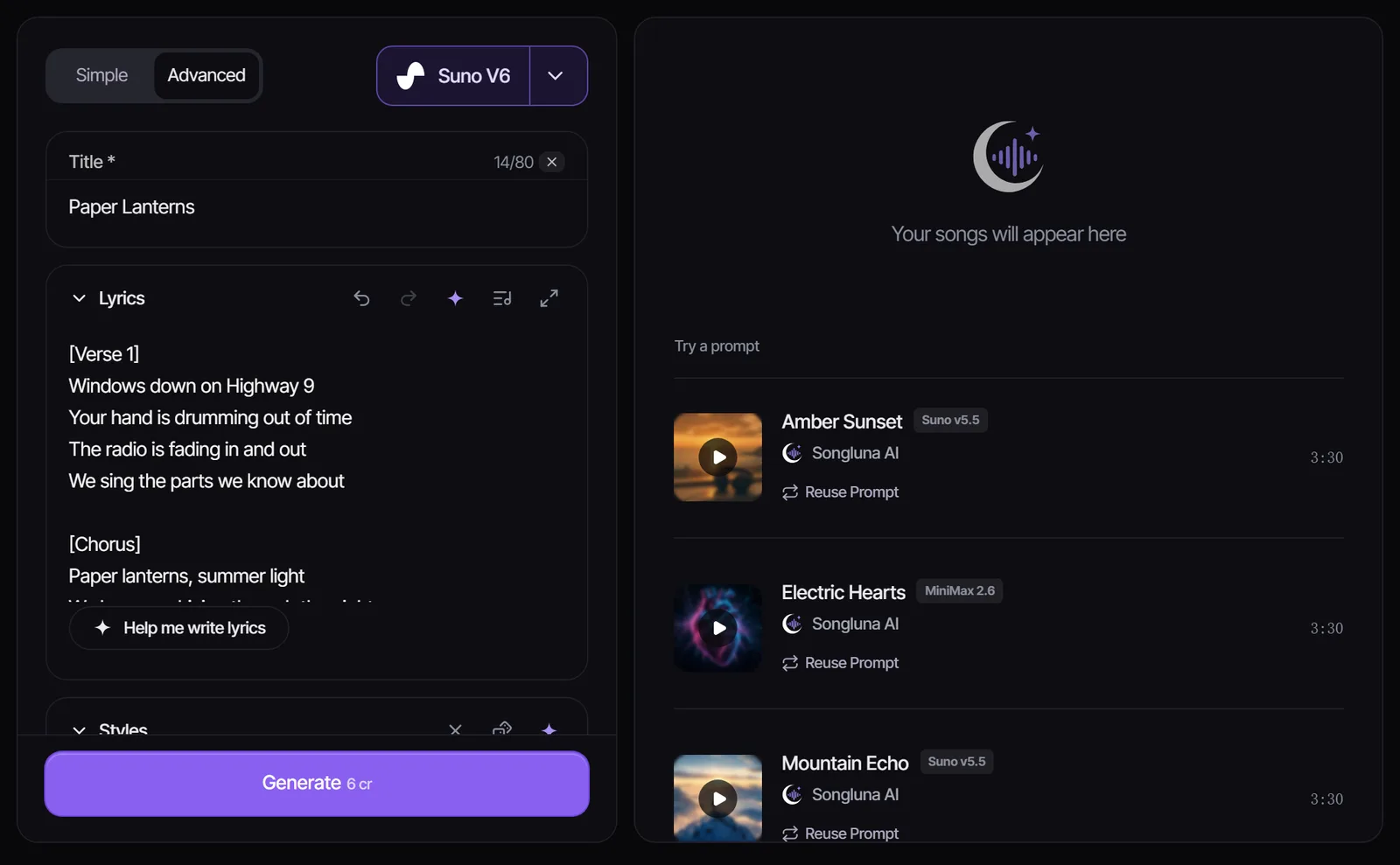
Suno-style generators give you two ways in. In a description mode you type one sentence about the song and the model writes the lyrics and style. In a custom mode, which gives far more control, the prompt is split into fields:
- Style: the sound of the song, as short comma-separated descriptors.
- Lyrics: the words to sing, with section tags. Leave it empty or mark sections [Instrumental] for no vocals.
- Exclude Styles: sounds or instruments to avoid.
- Title: the song name.
Instructions such as "make the chorus louder" belong in the lyrics as a section tag or in the style as a descriptor, not as a sentence to the model.
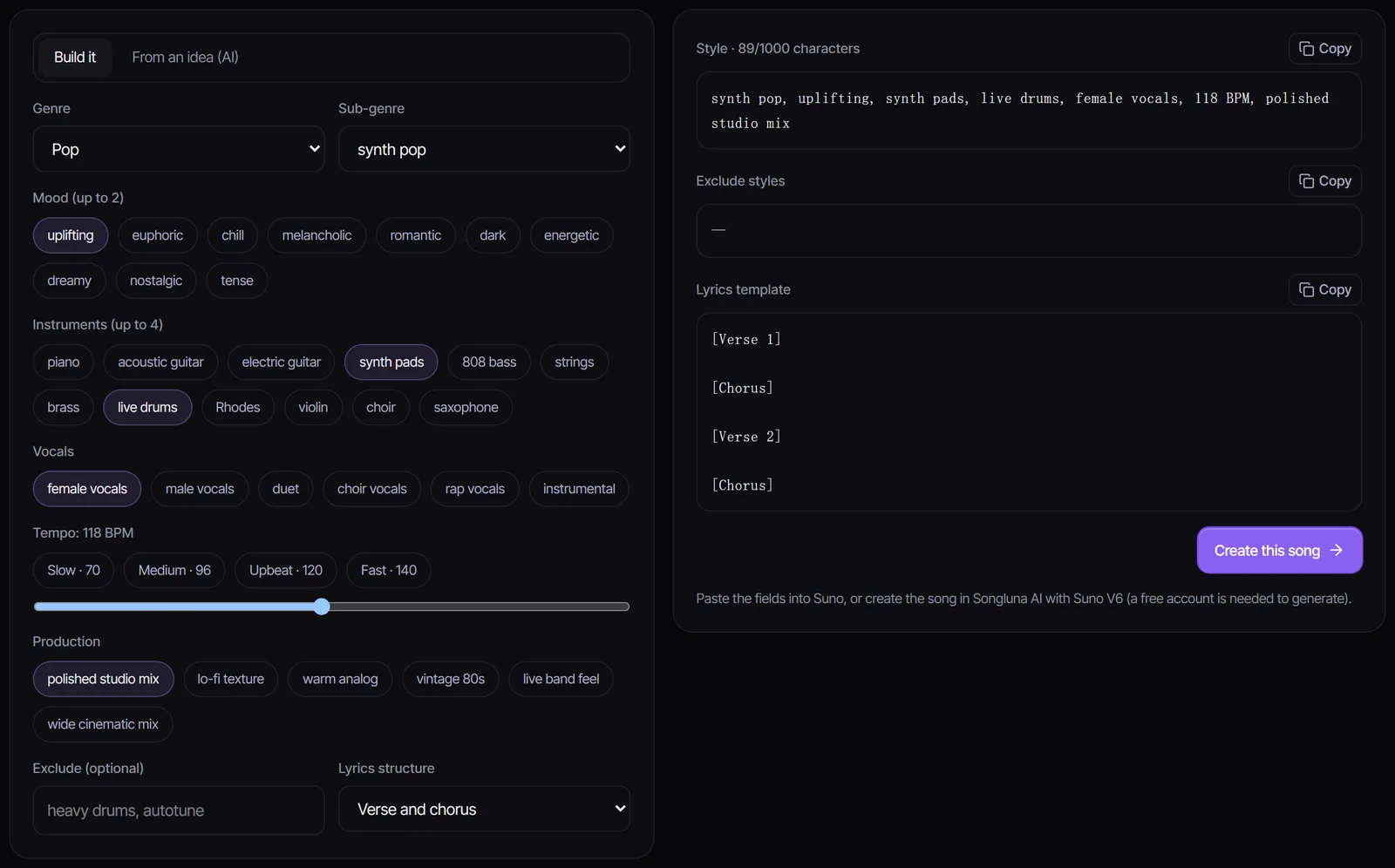
The style prompt formula
The order matters: the first descriptors carry the most weight. A reliable order is genre + mood + instruments + vocals + tempo + production, in 8 to 16 descriptors:
- Genre: "indie folk", "drill", "synthwave". Pick one main genre; a second as flavor at most.
- Mood: "nostalgic", "euphoric", "tense".
- Instruments: "fingerpicked acoustic guitar", "808 bass", "string section".
- Vocals: "soft female vocals", "raspy male vocals", "choir", or "instrumental".
- Tempo: a number, such as "96 BPM", instead of "slow" or "fast".
- Production: "lo-fi texture", "polished studio mix", "vintage 80s".
In Songluna AI the Style field takes up to 1,000 characters on Suno V4.5 and newer, and 200 on Suno V4, but the best prompts are usually under 300.
Suno prompt examples by genre
- Pop: synth pop, euphoric, bright synths, punchy drums, female vocals, 118 BPM, polished studio mix
- Indie folk: indie folk, nostalgic, fingerpicked acoustic guitar, soft harmonies, male vocals, 92 BPM, warm analog
- Hip hop: boom bap, gritty, dusty drums, jazz piano sample, confident rap vocals, 90 BPM, lo-fi texture
- Trap: trap, dark, 808 bass, crisp hi-hats, melodic rap vocals, 140 BPM, polished studio mix
- R&B: alt r&b, melancholic, warm keys, sparse snaps, smooth male vocals, 68 BPM, intimate mix
- Rock: alternative rock, energetic, distorted guitars, live drums, powerful female vocals, 128 BPM, live band feel
- Country: country pop, hopeful, acoustic guitar, pedal steel, male vocals, 100 BPM, warm analog
- EDM: future bass, euphoric, supersaw chords, vocal chops, female vocals, 150 BPM, wide mix
- House: house, groovy, four-on-the-floor kick, deep bass, soulful vocal samples, 124 BPM
- Lo-fi: lo-fi hip hop, chill, Rhodes, vinyl crackle, soft drums, instrumental, 80 BPM
- Cinematic: epic orchestral, tense, choir, brass, taiko drums, instrumental, 140 BPM, wide cinematic mix
- K-pop: k-pop, confident, glossy synths, trap drums, group vocals, 126 BPM, polished studio mix
Writing lyrics for Suno: metatags
Metatags are labels in square brackets that tell the model what each part of the lyrics is. Put each tag on its own line, and repeat the chorus with the same words every time.
- [Intro] an opening; leave it empty for an instrumental intro
- [Verse] the story; new words each time
- [Pre-Chorus] a short build into the chorus
- [Chorus] the hook, repeated word for word
- [Bridge] one contrasting section before the last chorus
- [Instrumental] or [Break] a section without vocals
- [Outro] the ending
Words in parentheses are often sung as backing vocals or ad-libs, for example "(oh-oh)". Keep the lines of a section a similar length so they fit the same melody.
Exclude Styles
Exclude Styles removes what keeps showing up. List two to five things, such as "heavy drums, autotune" or "electric guitar, male vocals". Do not repeat your genre here, and keep it to sounds, not sentences.
Common mistakes and how to fix them
- The song ignores your genre: move the genre to the start of the style and remove a second genre.
- There is no clear chorus: tag the chorus and repeat it with the same words.
- The wrong voice sings: state the vocal type in Style, such as "soft female vocals".
- An unwanted instrument appears: add it to Exclude Styles.
- Your prompt is refused: remove artist and song names and describe the sound instead.
- Every result sounds the same: change one descriptor at a time, such as the tempo or one instrument.
Using these prompts in Songluna AI
Suno V6, V5, V4.5 and V4 are available in the AI song generator. Paste the style into Styles and the lyrics into Lyrics in Advanced mode, or let the Suno Prompt Generator fill them in for you. A Suno V6 song costs 6 credits, and new accounts start with 8 free credits. What changed in the newest model, and how its prompts differ, is in the Suno V6 guide.
Suno is a trademark of its owner. Songluna AI is an independent product and is not affiliated with Suno.
Frequently asked questions
What is the best prompt structure for Suno?
Genre first, then mood, key instruments, the vocal type, a BPM number and a production word, in 8 to 16 short descriptors.
How long should a Suno style prompt be?
Usually under 300 characters. In Songluna AI the Style field accepts up to 1,000 characters on Suno V4.5 and newer and 200 on Suno V4.
Can I use artist names in Suno prompts?
Prompts with real artist names are often blocked. Describe the genre, mood, instruments and vocal style you like instead.
What are Suno metatags?
Labels in square brackets, such as [Verse], [Chorus] and [Bridge], that mark the sections of your lyrics. Each one goes on its own line.
Where do I put lyrics and where do I put the style?
Lyrics, with their section tags, go in the Lyrics field. Genre, mood, instruments, vocals and tempo go in Style.
Do prompts work the same on every Suno version?
The same structure works on all of them. Newer versions follow longer style prompts and lyrics more closely, so test your prompt on the model you plan to use.