Song Key Finder & BPM Finder
A song BPM finder and Camelot key finder in one: get the BPM, key and Camelot code of a song or loop. It runs in your browser, free and with no sign-in, and the audio is never uploaded.
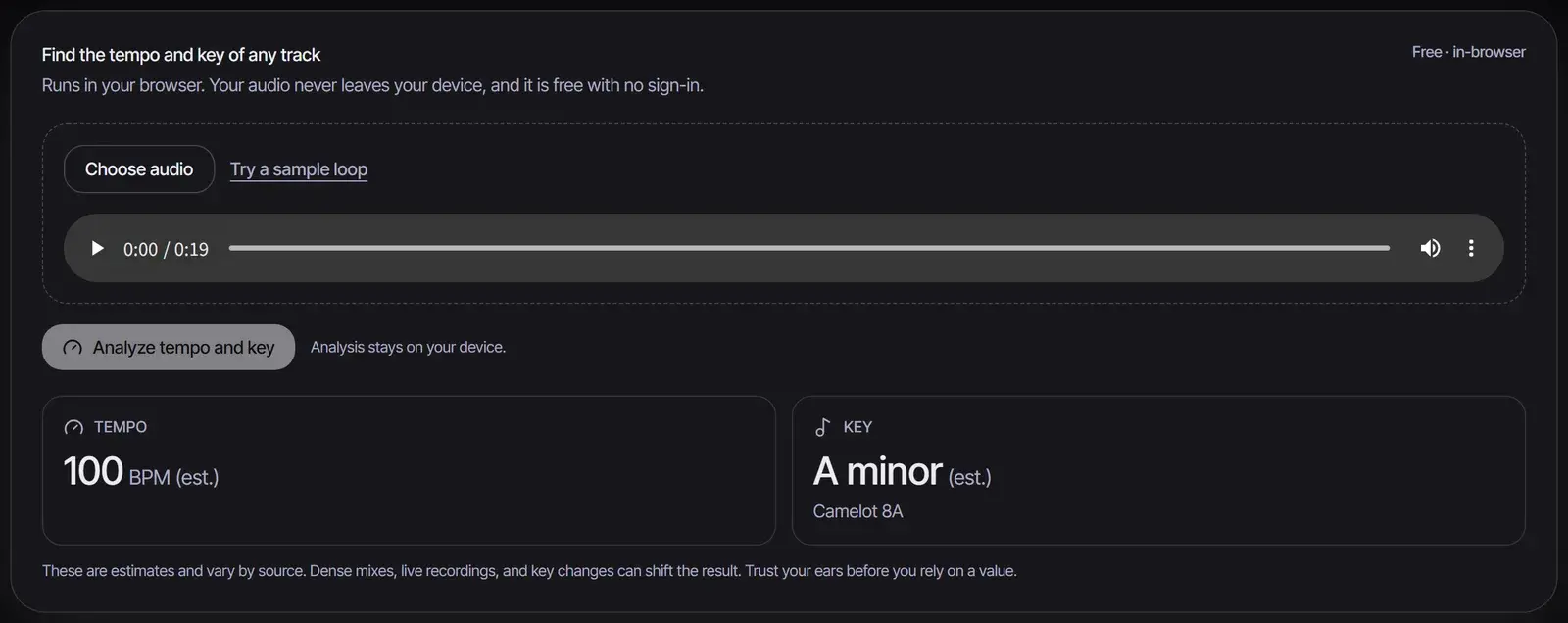
Find the tempo and key of any track
Runs in your browser. Your audio never leaves your device, and it is free with no sign-in.
How to find the key and BPM of a song
- 1
Choose a song or loop
Select Choose audio and pick an MP3, WAV, FLAC, M4A or AAC file. To see how it works first, select Try a sample loop.
- 2
Analyze tempo and key
Select Analyze tempo and key. The file is decoded and measured on your device, so longer songs take a little longer.
- 3
Read the tempo, key and Camelot code
The result shows the tempo in BPM, the key with major or minor, and its Camelot code. Check the values by ear before you rely on them.
What the key finder and BPM finder tell you
| Result | What it means | Example |
|---|---|---|
| Tempo (BPM) | Beats per minute: how fast the beat is | 100 BPM |
| Key | The tonal center of the song and whether it is major or minor | A minor |
| Camelot code | The key as a number from 1 to 12 plus A for minor or B for major, used by DJs for harmonic mixing | 8A |
The sample loop on this page is an original drum and chord loop written at 100 BPM in A minor. The finder reads it as 100 BPM, A minor, Camelot 8A.
How the key and tempo are detected
- Tempo: the audio is scanned for beat onsets, and the most consistent spacing between them becomes the BPM (web-audio-beat-detector, MIT license).
- Key: the energy of each of the 12 pitch classes is averaged across the song (Meyda chroma features) and compared with the Krumhansl–Kessler major and minor key profiles. The closest of the 24 keys wins.
- Everything runs in your browser tab. Nothing is uploaded, and there is no limit on how many files you check.
Results are estimates. Key changes, dense mixes, live tempo drift and unusual tuning can all move the result, so trust your ears when a value matters.
Why a BPM can read as half or double
The finder reports tempos between 90 and 180 BPM. A ballad at 70 BPM reads as 140, and a drum and bass track at 190 BPM reads as 95: both describe the same beat grid counted at a different level. If the number feels twice as fast or slow as the song, halve or double it.
| Song tempo | Usually reads as | Why |
|---|---|---|
| 70 BPM ballad | 140 BPM | Below 90, so it is counted in eighth notes |
| 85 BPM hip hop beat | 170 BPM | Below 90, so it is doubled |
| 128 BPM house track | 128 BPM | Inside the range |
| 174 BPM drum and bass | 174 BPM | Inside the range |
| 190 BPM punk song | 95 BPM | Above 180, so it is halved |
Camelot wheel: every key and its code
Two tracks usually mix smoothly when their Camelot codes match, sit one number apart, or share the number with the other letter. For example, 8A works with 7A, 9A and 8B.
| Number | Minor key (A) | Major key (B) |
|---|---|---|
| 1 | G♯ (A♭) minor | B major |
| 2 | D♯ (E♭) minor | F♯ (G♭) major |
| 3 | A♯ (B♭) minor | C♯ (D♭) major |
| 4 | F minor | G♯ (A♭) major |
| 5 | C minor | D♯ (E♭) major |
| 6 | G minor | A♯ (B♭) major |
| 7 | D minor | F major |
| 8 | A minor | C major |
| 9 | E minor | G major |
| 10 | B minor | D major |
| 11 | F♯ minor | A major |
| 12 | C♯ minor | E major |
Getting an accurate reading
- Use the whole song, or at least 30 seconds with a steady beat.
- A song that changes key reports the key that dominates overall.
- Relative keys share the same notes, such as A minor and C major, so the finder can name either one. The Camelot number stays the same (8A and 8B).
- Live recordings with a drifting tempo give an average BPM.
- Heavily distorted mixes, constant pitch bends and atonal music make the key unclear; the finder says so when it finds no clear key.
What to do with the key and tempo
- Move a song to another key with the Pitch Changer, to fit your voice or the next track in a DJ set.
- Match tempos with the Music Speed Changer: the speed to set is the target BPM divided by the current BPM.
- Write chords in the same key with the Chord Progression Generator.
- Use the key and tempo as a guide in a prompt for the AI song generator, such as "lo-fi hip hop in A minor, 85 BPM".
Frequently asked questions
How do I find the key of a song?
Choose the audio file and select Analyze tempo and key. The finder shows the key, such as A minor, with its Camelot code.
How do I find the BPM of a song?
Upload the song and analyze it; the tempo appears in beats per minute. To double-check, count the beats for 15 seconds and multiply by 4.
Is the key and BPM finder free?
Yes. It runs in your browser with no account, no credits and no limit.
Is my audio uploaded?
No. The file is decoded and analyzed on your device and never leaves the browser.
What is a Camelot key?
A DJ notation that turns the 24 keys into the numbers 1 to 12 plus A for minor or B for major. Neighboring codes mix in key.
Why is the BPM half or double what I expected?
The finder reports tempos from 90 to 180 BPM, so slower songs read doubled and faster songs read halved. Halve or double the number to match how the song feels.
Can I look up a song by name?
No. It analyzes files you have instead of searching a database, so it also works on unreleased tracks, stems and loops.
Which file formats work?
MP3, WAV, FLAC, M4A and AAC.
How accurate is it?
Steady, tonal music usually reads correctly. The key can land on the relative key, and songs with key changes or loose timing give a best overall estimate.
Sources
Updated October 25, 2026 · Written and reviewed by the Songluna AI team
Make a song in that key and tempo
Describe the style, key and BPM in the AI Music Generator. New accounts get 8 free credits.