How to Read Music: A Beginner's Guide to Reading Sheet Music (2026)
How to read music, step by step: the staff, treble and bass clef notes, note values, rhythm, time and key signatures, with charts and free tools to practice.
Reading music is like reading a map of a song: it shows which notes to play, how long to hold them, and how loud to play them. Learning how to read sheet music takes an afternoon for the basics and a few minutes of practice a day to get comfortable. This guide shows how to read music step by step, with charts for treble clef notes, bass clef notes and note values, and free tools to turn songs into notation you can practice with.
How to read music: the short version
- Learn the staff: five lines and four spaces, read from left to right.
- Learn the notes on the treble clef and the bass clef, using the memory aids below.
- Learn how long each note lasts: whole, half, quarter, eighth and sixteenth notes.
- Read the time signature to know how to count each bar.
- Read the key signature to know which notes are sharp or flat.
- Practice slowly: name the notes, clap the rhythm, then play or sing.
Step 1: The staff and the musical alphabet
Music is written on a staff of five lines and four spaces. Each line and each space stands for a note, and the higher a note sits on the staff, the higher it sounds. Notes use only seven letters, A to G, which repeat: after G comes A again, one octave higher.
When a note is too high or too low for the staff, short extra lines called ledger lines extend it. Vertical bar lines divide the music into bars (also called measures), which makes it easier to count. Once you know how to read notes on the staff, the rest is rhythm and markings.
Step 2: Treble clef notes
The symbol at the start of the staff, the clef, tells you which notes the lines and spaces are. The treble clef (or G clef) curls around the second line from the bottom, which is G. It is used for higher notes: the right hand on the piano, the violin, the flute, and most singing.
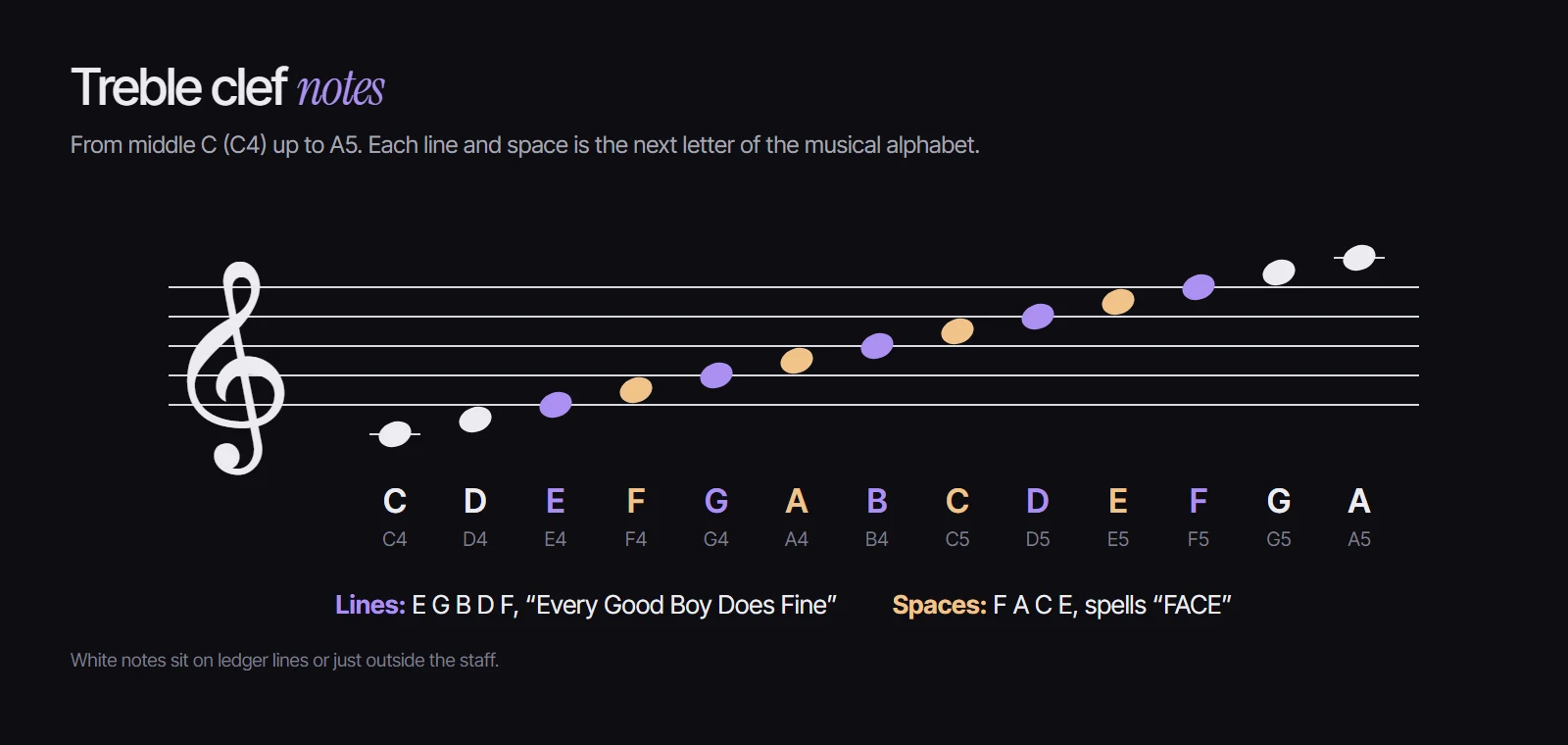
- Lines, bottom to top: E, G, B, D, F, remembered as "Every Good Boy Does Fine".
- Spaces, bottom to top: F, A, C, E, which spells "FACE".
- Middle C sits on the first ledger line below the treble staff.
Step 3: Bass clef notes
The bass clef (or F clef) marks the fourth line from the bottom as F: its two dots sit on either side of that line. It is used for lower notes: the left hand on the piano, bass guitar, cello and low voices.
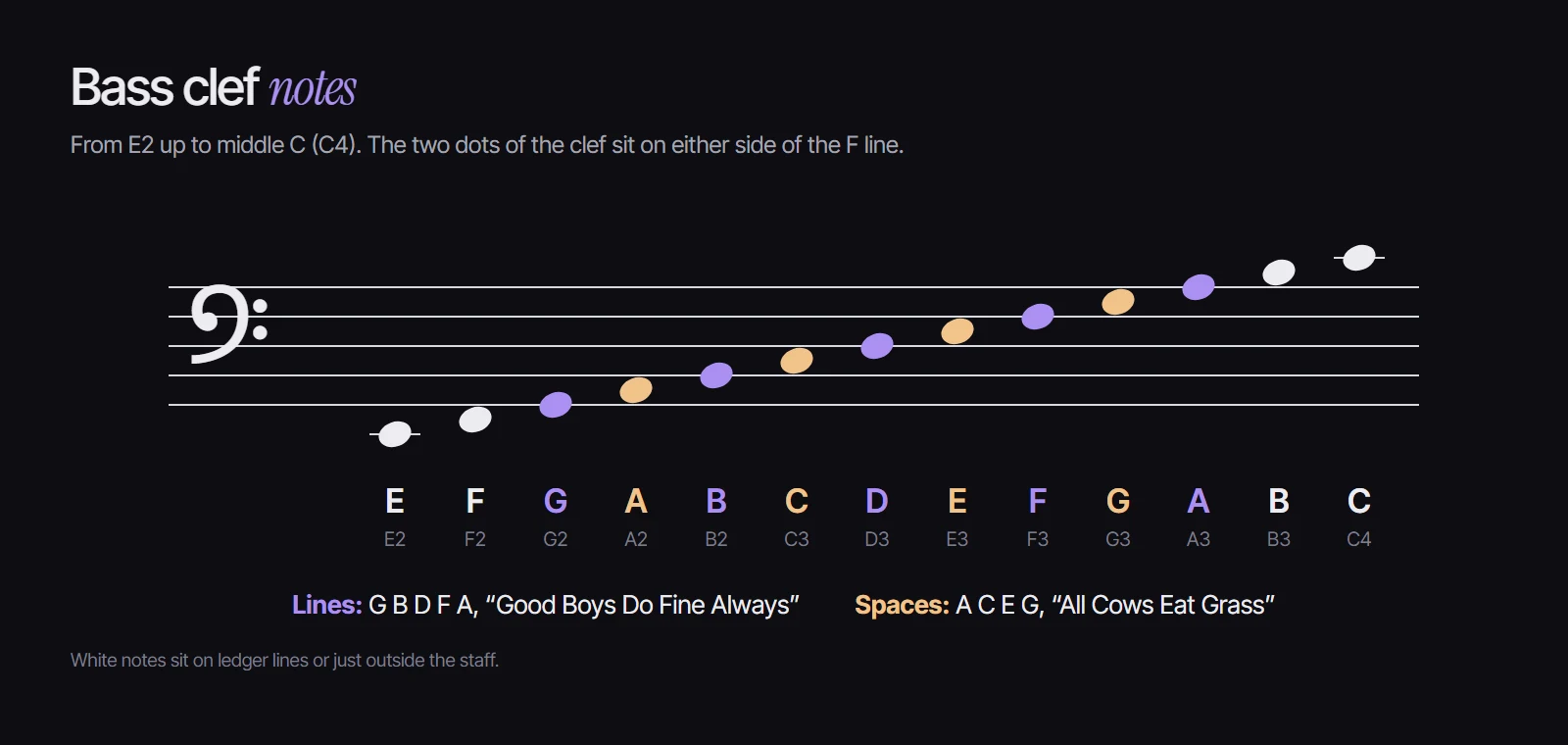
- Lines, bottom to top: G, B, D, F, A, remembered as "Good Boys Do Fine Always".
- Spaces, bottom to top: A, C, E, G, remembered as "All Cows Eat Grass".
- Middle C sits on the first ledger line above the bass staff.
Step 4: Note values and rests
The shape of a note tells you how long it lasts. In 4/4 time, where a quarter note gets one beat:
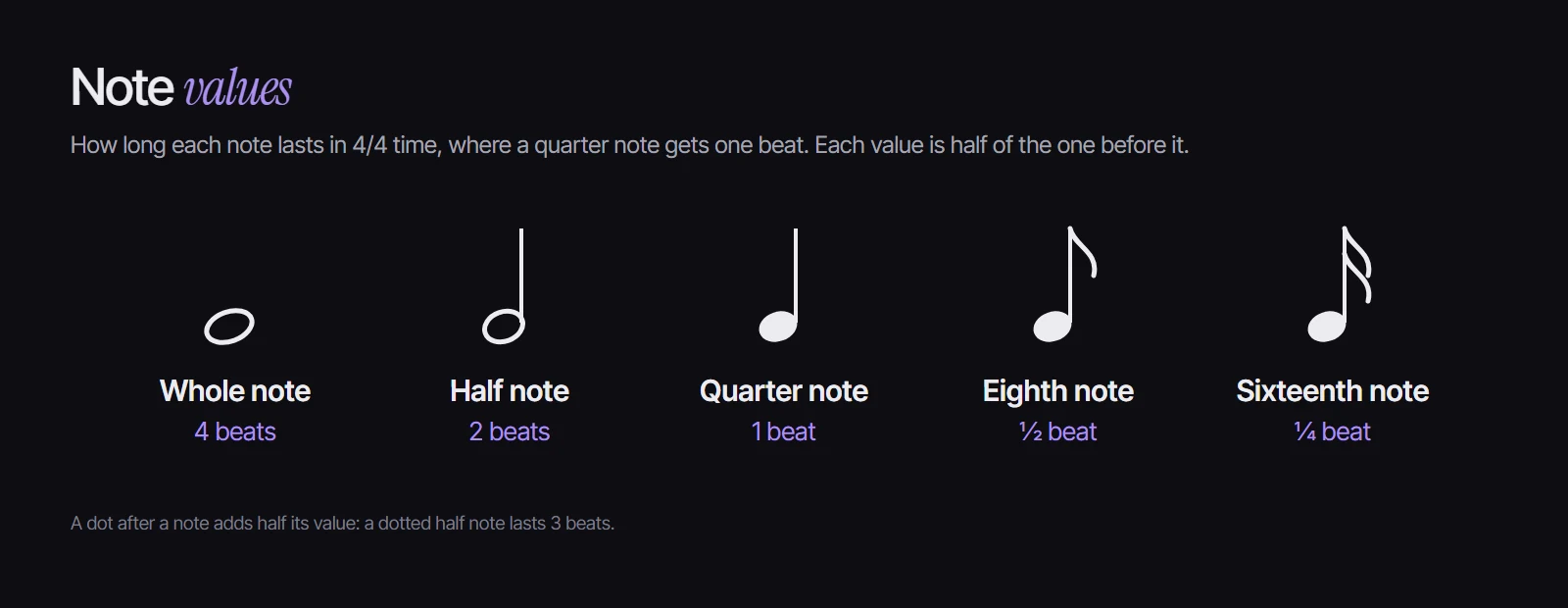
- Whole note (hollow, no stem): 4 beats.
- Half note (hollow, with a stem): 2 beats.
- Quarter note (filled, with a stem): 1 beat.
- Eighth note (one flag, or joined by one beam): half a beat.
- Sixteenth note (two flags or beams): a quarter of a beat.
Every note value has a matching rest, a symbol for silence of the same length. A dot after a note adds half of its value, so a dotted half note lasts 3 beats. A curved tie joins two notes of the same pitch into one longer note.
Step 5: Time signatures and counting
The two numbers after the clef are the time signature. The top number is how many beats are in each bar; the bottom number is which note gets one beat (4 means a quarter note).
- 4/4: four quarter-note beats per bar, the most common time signature. Count "1, 2, 3, 4".
- 3/4: three beats per bar, the feel of a waltz. Count "1, 2, 3".
- 6/8: six eighth notes per bar, felt as two groups of three. Count "1, 2, 3, 4, 5, 6".
For eighth notes, count "1 and 2 and 3 and 4 and", with a note on every number and every "and".
Step 6: Key signatures and accidentals
Sharps (♯) and flats (♭) placed right after the clef form the key signature. They apply to that note in every octave for the whole piece: one sharp on the F line means every F is played as F sharp.
Accidentals are sharps, flats or naturals (♮) written in front of a single note. They last until the end of that bar. A sharp raises a note by a half step, a flat lowers it by a half step, and a natural cancels both.
Step 7: Dynamics and other markings
- Dynamics show how loud to play: p (piano, soft), mp, mf, f (forte, loud). A long opening wedge (crescendo) means get louder; a closing one (diminuendo) means get softer.
- Tempo is written in words such as Allegro or as a number of beats per minute. The BPM guide explains both.
- Repeat signs (two dots beside a double bar line) mean play that section again.
- A fermata (an arc over a dot) means hold the note longer than written.
How to read piano sheet music
Piano music uses a grand staff: a treble staff on top for the right hand and a bass staff below for the left, joined by a brace. Middle C sits between them, on a ledger line below the treble staff or above the bass staff. Read each hand on its own first, then put them together slowly.
How to practice reading music
Try one bar, then check your answer
Use a treble clef, no sharps or flats, and 4/4 time. The four notes are the lowest line, the space just above it, the next line, and that first space again. Each note is a quarter note.
Name the pitches before checking: E4, F4, G4, F4. Count them evenly as 1, 2, 3, 4. The sequence moves up by step twice and down by step once.
For a rhythm variation, keep the first two quarter notes and replace the final two with one half note. The pitches become E4, F4, G4; count 1, 2, 3–4, holding G through the fourth beat. Each version still fills one complete 4/4 bar.
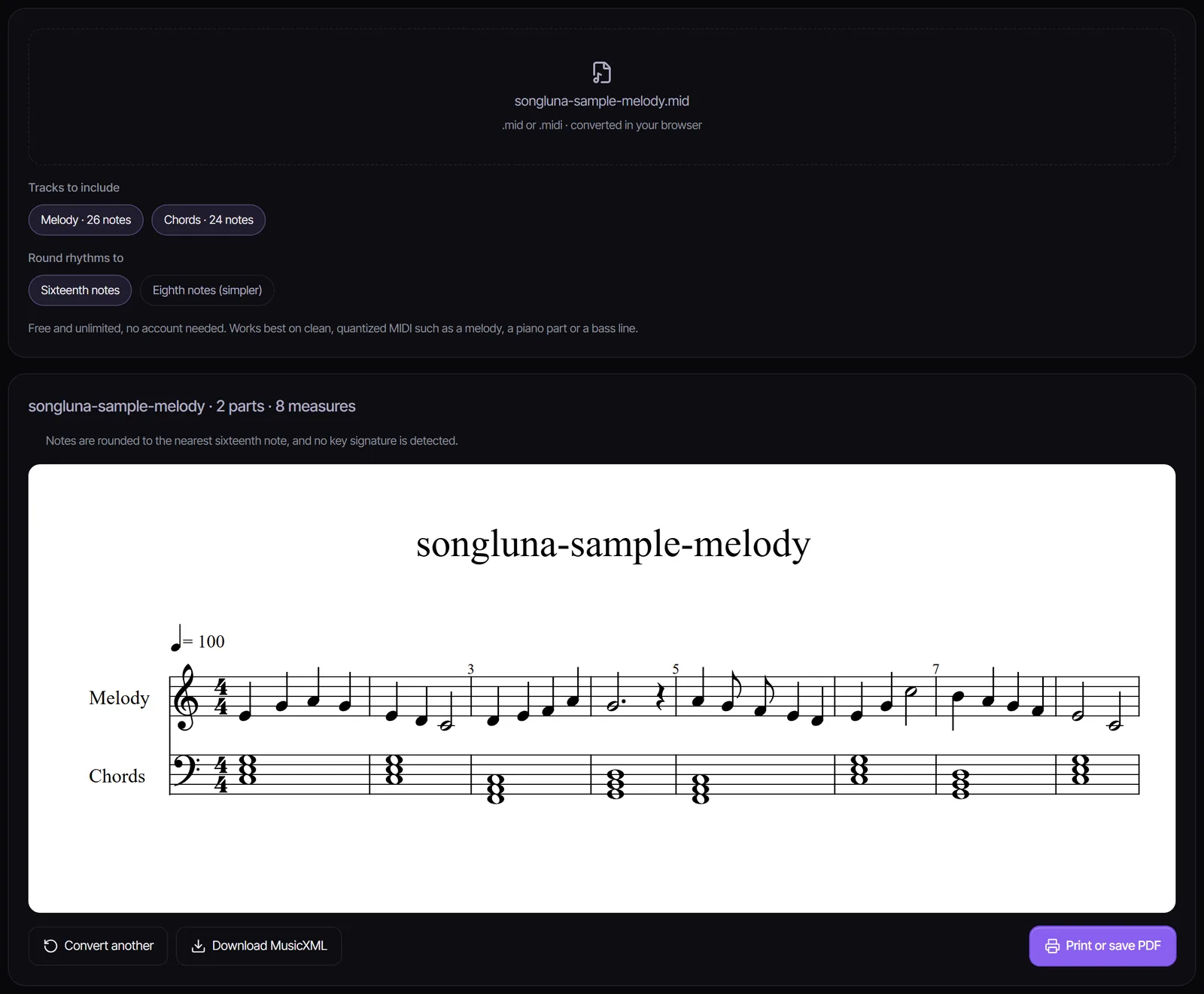
Enter those pitches in the MIDI Editor, set a slow tempo and play them back. Export the MIDI to MIDI to Sheet Music to compare the written notes with what you heard.
Build a short daily practice
- Read a little every day. Five minutes daily beats an hour once a week.
- Name the notes before you play. Say them out loud, then play them.
- Clap the rhythm first. Get the counting right before adding pitch.
- Use music you know. Turn a melody you like into notation: convert a recording with MP3 to MIDI, then print it with MIDI to Sheet Music.
Frequently asked questions
How long does it take to learn to read music?
Most beginners learn the note names and basic rhythms in a few days of short practice. Reading fluently, without stopping to work out each note, usually takes a few months of daily reading.
Can I learn to read music on my own?
Yes. Learn the staff, the clefs and the note values from a guide like this one, then read simple pieces slowly every day. A teacher helps with technique, but reading itself is very learnable alone.
How do I read notes faster?
Learn landmark notes first (middle C, treble G and bass F), and read the distance between notes instead of naming each one: a step to the next line or space, or a skip over one.
What is middle C?
The C closest to the middle of the piano keyboard, also called C4. It sits on a ledger line between the treble and bass staves and is the reference point for both clefs.
Is reading music the same for every instrument?
The staff, notes and rhythms work the same way. Instruments differ in which clef they read and, for some like the trumpet and clarinet, in how written notes map to the notes that sound.