What Is MIDI? Meaning, MIDI Files and How MIDI Works (2026)
What is MIDI: what MIDI stands for, how MIDI messages and MIDI files work, how MIDI differs from audio, and free tools to convert, edit and print MIDI.
MIDI is the language electronic instruments and music software use to talk to each other. It does not carry sound: it carries instructions, such as which note to play, how hard and for how long. That is why one MIDI file can be played by a piano, a synth or a full orchestra. This guide explains what MIDI is, what a MIDI file contains, how MIDI differs from audio, and what you can do with it for free.
What does MIDI stand for?
MIDI stands for Musical Instrument Digital Interface. It was introduced in 1983 so that keyboards and other gear from different manufacturers could work together, and it is still the standard today (Wikipedia). The MIDI meaning in everyday use is simply "note data": the notes and timing of a performance, without the sound itself.
How MIDI works
When you press a key on a MIDI keyboard, it sends a short message instead of audio. The most common messages are:
- Note on and note off: which note starts and stops. Notes are numbered 0 to 127; middle C is note 60.
- Velocity: how hard the note was played, from 1 to 127, which usually controls loudness.
- Control change: knobs, pedals and sliders, such as the sustain pedal or the modulation wheel.
- Program change: which instrument sound to use.
- Pitch bend: smooth slides between notes.
A single MIDI connection carries 16 channels, so one cable or file can control 16 different instruments at once. The receiving instrument or software turns these messages into sound.
What is a MIDI file?
A MIDI file (usually .mid) stores those messages with their timing, plus the tempo and time signature. A three-minute song can fit in a few kilobytes because there is no audio inside. When you open the file, your software plays the notes with whatever instruments it has. Most players follow General MIDI, a standard list of 128 instrument sounds, so a file sounds roughly the same everywhere: program 1 is a piano, program 33 an acoustic bass, and so on.
MIDI vs audio
- Audio (MP3, WAV) is a recording of sound. You can hear it anywhere, but you cannot easily change a single note.
- MIDI is a list of notes. You cannot hear it without an instrument, but you can change any note, the tempo, the key or the instrument in seconds.
Producers often write parts in MIDI, adjust them until they are right, then render them to audio for the final song.
What you can do with MIDI
- Change the sound: play the same melody with a piano, strings or a synth.
- Fix mistakes: move a wrong note or tighten the timing without re-recording.
- Change key or tempo without any loss in quality.
- Print it: MIDI converts directly into sheet music.
- Control instruments: play software instruments from a MIDI keyboard, drum pad or controller.
MIDI 2.0
MIDI 2.0 was adopted at the Winter NAMM Show in January 2020 (Wikipedia). It adds much finer resolution for velocity and controllers, two-way communication so devices can describe their capabilities, and more channels, while staying compatible with MIDI 1.0 gear. MIDI files and everyday tools still mostly use MIDI 1.0, which works with everything.
Free MIDI tools
Songluna AI has free browser tools for every step:
- Audio to MIDI: MP3 to MIDI turns a recording of a melody or a song into MIDI notes.
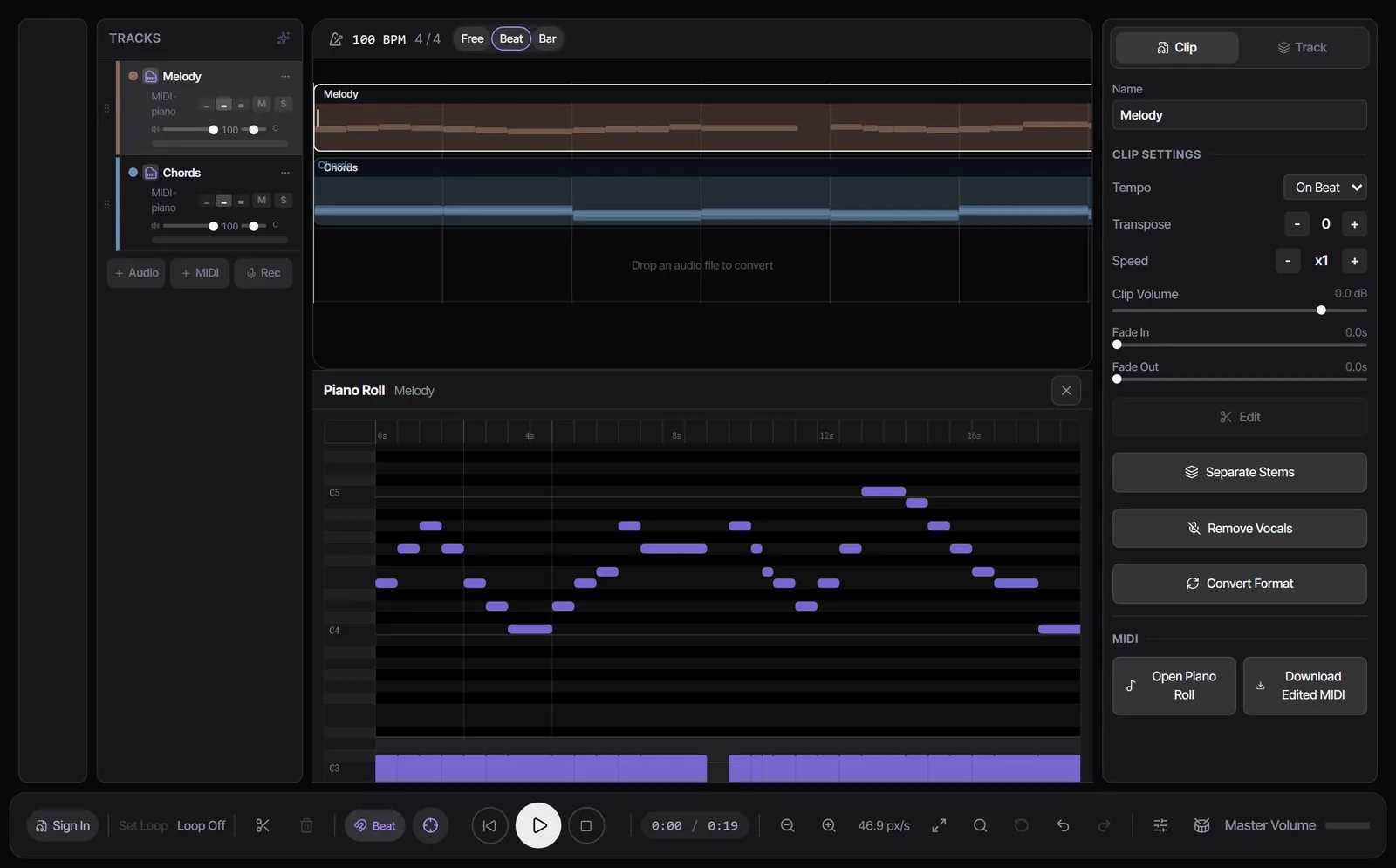
- Edit: the MIDI Editor opens a MIDI file in a piano roll, so you can move notes, change their length and export the result.
- Print: MIDI to Sheet Music engraves a MIDI file as notation, and MusicXML to MIDI goes the other way.
- Create: the Chord Progression Generator and the Melody Generator write chords and melodies you can download as MIDI.
New to notation? The guide to reading music explains the staff, clefs and note values.
Frequently asked questions
Is MIDI audio?
No. MIDI is note data: which notes, when, how hard. It needs an instrument, either hardware or software, to make sound.
What is a MIDI file used for?
Sharing and editing performances. Musicians use MIDI files for backing tracks, karaoke, video game music, practice, notation and as a starting point for production in a DAW.
Can I convert MIDI to MP3?
Yes, by playing it through instruments and recording the result. The MIDI Editor can export your MIDI as a WAV file, which any converter can turn into an MP3.
Can I convert MP3 to MIDI?
Yes. MP3 to MIDI detects the notes in a recording and writes them as MIDI. Clear, single melodies convert most accurately; full mixes give a rougher result.
What is a MIDI keyboard?
A keyboard that sends MIDI instead of making its own sound. Plug it into a computer or tablet and it plays the software instruments in your music app.