
Suno V6 Guide: What's New, the Three Models and How to Prompt It (2026)
Suno V6 explained: what changed, how v6, v6-wild and v6-mini differ, how it compares with V5, and how to write prompts for it. Try Suno V6 in Songluna AI.
Suno released V6 on September 9, 2026, as a new generation of music models rather than a single update. This guide covers what Suno says changed, how the three V6 models differ, how to write prompts that suit V6, and how it compares with V5. Claims about quality are Suno's own unless a source says otherwise; listen to a few takes before you decide.
You can try Suno V6 without a Suno subscription in the AI song maker: a generation costs 6 credits, and new Songluna AI accounts get 8 free credits.
Suno V6 at a glance
- Released: September 9, 2026, announced by Suno's co-founder and CEO in Introducing v6.
- Models: v6, the flagship; v6-wild, for exploring; v6-mini, a faster, lighter model.
- Access on suno.com: v6 and v6-wild for Pro and Premier subscribers; v6-mini for everyone.
- Partners: Suno says it developed V6 with Warner Music Group, BMG and Believe.
- Older models: Suno says it is retiring its previous models as V6 rolls out on suno.com.
- In Songluna AI: Suno V6 sits in the model menu next to Suno V5, V4.5 and V4, costs 6 credits a generation and makes songs up to 8 minutes long.
What's new in Suno V6
Suno describes the V6 models as faster, more expressive and higher quality than its earlier models, and says they understand more of the language and building blocks musicians use. In practice that means terms like a time signature, a playing style or a mix choice are more likely to be followed than before.
On suno.com, V6 also arrived with new ways to create and edit:
- Start from more than text: a written idea, a voice memo, an image or a video.
- Edit part of a song: change one section in plain language and leave the rest alone, or change a single lyric without regenerating the song.
- Combine songs: build a mashup from several songs in one request, or sample a riff and build a new beat around it.
Those features belong to Suno's own app. In Songluna AI, Suno V6 creates songs from a description or from your lyrics and style, and separate tools cover similar jobs: the AI Lyric Changer rewrites lyrics in an existing song, the AI Music Extender adds an intro, an outro or more length, and the AI Song Remixer restyles a track.
v6 vs v6-wild vs v6-mini
Suno positions the three models for different moments in a project:
- v6: reliable, precise and consistent across genres. Use it when you know what you want and are finishing a track. It follows detailed prompts closely, so a vague prompt tends to give a clean but generic result.
- v6-wild: less predictable and more varied, made for exploring. It treats the prompt more loosely, so moods and images often work better than technical detail. Suno says results can be taken into v6 to refine them.
- v6-mini: faster and more efficient, and the model free users get on suno.com. Shorter prompts with the three or four things that matter most tend to work best.
Songluna AI offers one Suno V6 model in its model menu; v6-wild and v6-mini are options inside Suno's own app.
How was Suno V6 trained?
Suno's announcement says V6 was developed "with our industry partners" Warner Music Group, BMG and Believe. Music Business Worldwide reported the launch as a partnership with those three companies, and later reported that Suno described V6's training as licensed content from its partners, creations and preference signals from its users, and internal learnings. Universal Music Group and Sony Music, which are not partners, are still suing Suno and argue that V6 derives from earlier models trained on their recordings.
What this means for you: songs you make are covered by the terms of the service you make them on, not by Suno's label deals. The AI music copyright guide explains who owns AI-made songs and how commercial use works.
How to write prompts for Suno V6
Because V6 reads musician vocabulary better, specific prompts pay off more than they did on older models. The Suno prompt guide covers the full style formula and metatags; these are the parts that matter most on V6.
Build the style in layers. Put the most important descriptors first, in roughly this order:
- Genre and sub-genre, a BPM number, and a time signature if it is not 4/4.
- The vocal: tone, gender and delivery, such as "breathy female vocals" or "gritty male rap".
- Two to four instruments with how they are played, such as "fingerpicked acoustic guitar".
- Energy and arrangement: where the song builds, drops or breaks down.
- Production and mix, such as "warm analog tape" or "wide, polished pop mix".
- How it ends, such as "fades out on the chorus" or "ends on a single piano chord".
Be specific instead of general. Compare these two style prompts:
lo-fi hip hop, chilllo-fi hip hop, 78 BPM, dusty boom bap drums, Rhodes chords with tape wobble, upright bass, soft hummed female vocals, vinyl crackle, sparse intro, ends on a fading Rhodes chordThe first gives V6 almost nothing to follow; the second describes a track it can actually build.
Use the lyrics box for structure. Put [Verse], [Chorus], [Bridge] and similar tags on their own lines. You can also try short directions inside a tag, such as [Bridge: half-time, stripped back] or [Chorus: gang vocals], to change the arrangement for one section.
Use the controls. In Songluna AI's Advanced mode, open More Options: list what you do not want in Negative Tags, raise Style strength to follow the style more closely, and raise Creativity for less predictable results.
Re-test old prompts. V6 was trained on a new set of data, so a prompt tuned on V5 can sound different on V6. Generate two or three takes before you rewrite it.
Want the prompt built for you? The free Suno Prompt Generator turns a few choices into a style prompt and a lyrics template.
Suno V6 vs V5
There are no independent listening tests of V6 yet, so the comparison below sticks to what is documented:
- Training: V6 is a new generation trained on a different set of data; V5 belongs to the earlier generation.
- Prompt understanding: Suno says V6 understands more musician vocabulary, so specific prompts matter more.
- Features on suno.com: creating from voice memos, images and video, and editing one section or one lyric, arrived with V6.
- Availability: suno.com is moving every user to V6. In Songluna AI, both V6 and V5 stay in the model menu, each at 6 credits a generation and up to 8 minutes a song.
Which to choose: V6 for new songs. V5 when you are matching songs you already made on V5 or reusing a prompt you tuned on it.
How to use Suno V6 in Songluna AI
- Open the AI song maker and choose Suno V6 in the model menu.
- For a quick draft, describe the song in one or two sentences.
- For more control, switch to Advanced mode: paste your lyrics with section tags, write the style prompt, and add anything to avoid in Negative Tags under More Options. Have lyrics already? Lyrics to Song opens with the lyrics editor ready.
- Generate, listen to both takes, and change one thing at a time.
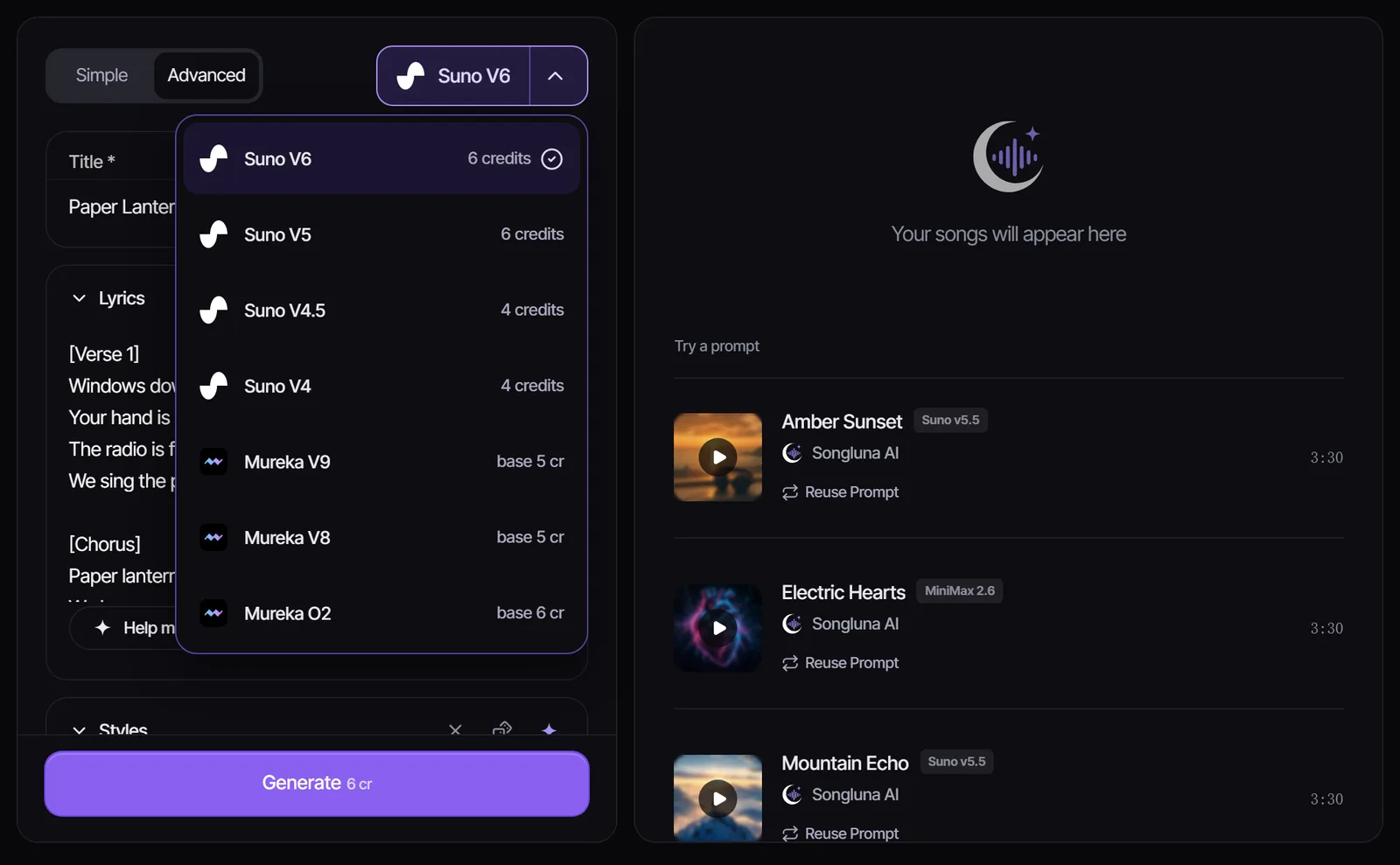
A Suno V6 generation costs 6 credits, and new accounts start with 8 free credits. Songs made on the Free plan are for personal use; paid plans (Plus and Pro) include commercial-use rights for eligible music.
Suno is a trademark of its owner. Songluna AI is an independent product and is not affiliated with Suno.
Frequently asked questions
What is the Suno V6 release date?
Suno released V6 on September 9, 2026, as a family of three models: v6, v6-wild and v6-mini.
Is Suno V6 free?
On suno.com, v6-mini is available to everyone, while v6 and v6-wild need a Pro or Premier subscription. In Songluna AI, a Suno V6 generation costs 6 credits, and new accounts get 8 free credits.
What is the difference between v6 and v6-wild?
v6 is precise and consistent, for finishing songs. v6-wild is less predictable and more varied, for exploring ideas; Suno says you can take a v6-wild result into v6 to refine it.
Was Suno V6 trained on licensed music?
Suno says it developed V6 with Warner Music Group, BMG and Believe, and has described the training as licensed partner content plus user creations and preference signals. Universal and Sony, which are not partners, are still suing Suno.
Do my Suno V5 prompts still work on V6?
The same structure works, but results can differ because V6 was trained on new data. Expect to adjust: add specific instruments, tempo and vocal details, and generate a few takes.
Can I still use Suno V5?
Suno is retiring older models on suno.com. In Songluna AI, Suno V5, V4.5 and V4 remain available next to V6.